

Abstract:
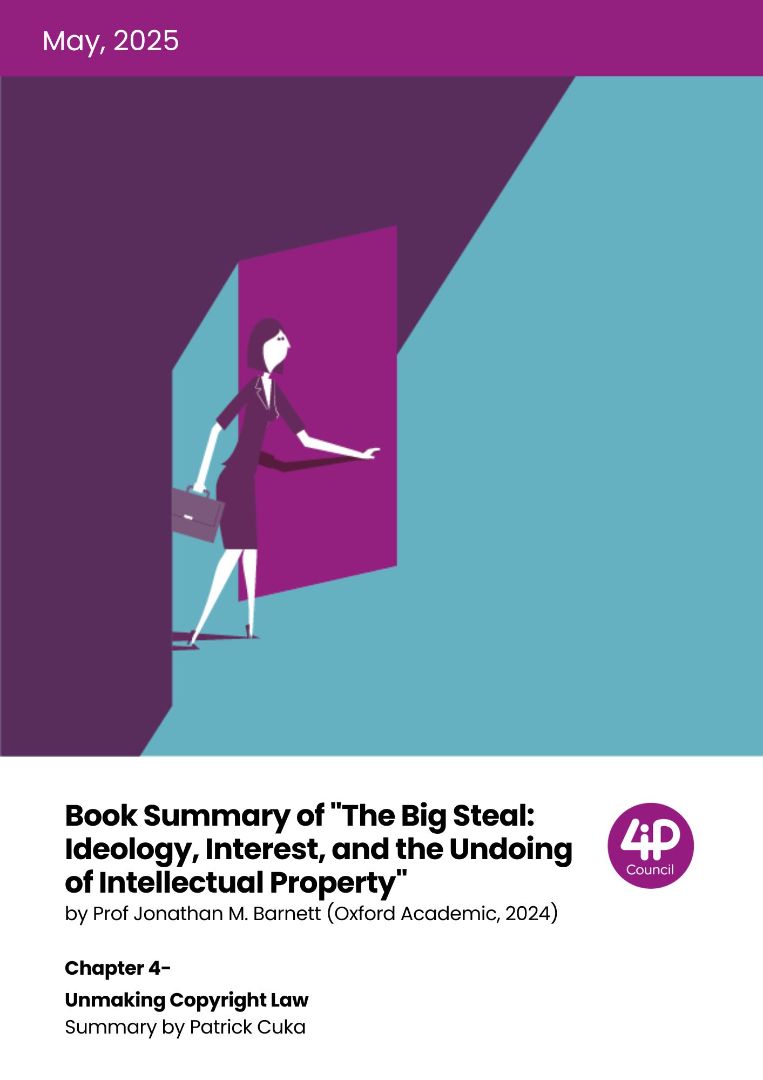
This chapter examines the expansion of the fair use doctrine in U.S. copyright law. Over time, U.S. courts have broadened the scope of fair use, which has particularly benefited digital platforms like Google. Key rulings, such as Campbell v. Acuff-Rose and Oracle v. Google, reshaped fair use, emphasizing “transformative use” over market harm. This shift weakened copyright protections, favoring content aggregators over original creators. Global advocacy efforts pushed similar fair use expansions internationally, impacting copyright enforcement. The economic and political interests behind these legal changes prioritized access over creator compensation. The evolving interpretation of fair use raises concerns about the future of intellectual property rights.
Chapters in the Book:
- Part II – Unmaking Copyright Law
- Chapter 4 - The Rise of Unfair Use (p.81-109)
Summary
4. The Rise of Unfair Use
Fair use is a doctrine in copyright law that allows the use of copyrighted material without permission from the copyright holder. The doctrine as it is currently applied differs significantly from its original interpretation and codification in1976. This chapter explores how courts expanded its scope over time. This expansion benefits search engines and content aggregators that rely on using third-party content without direct licensing or payment to copyright owners. Google played a key role in reshaping fair use by securing favourable rulings in landmark cases involving Google Books, Google Images, and the Android operating system. Academic and advocacy groups supported these legal shifts, reinforcing arguments that broader fair use exemptions benefit information access and innovation. These legal changes altered competition in content and information markets, redefining copyright boundaries to favour digital intermediaries over traditional content creators.
4.1. Judicial Expansion of the Fair Use Doctrine
The currently broad interpretation of fair use, especially “transformative use,” is often linked to the Supreme Court’s 1994 Campbell v. Acuff-Rose decision. However, the Court likely did not intend to significantly expand fair use. Instead, this broader interpretation emerged from lower-court rulings about a decade later. Some decisions have stretched fair use so far that they conflict with copyright owners’ derivative rights which are explicitly protected under copyright law. In response to this tension, the Supreme Court’s 2023 Warhol Foundation v. Goldsmith decision-imposed limits on the fair use exemption. This ruling signals a shift toward restoring balance between copyright protections and the expanded interpretations that favored digital platforms.
4.1.1. The Backstory
The fair use doctrine began with the 1841 Folsom Marsh decision, where Justice Story allowed limited copying for “fair and reasonable criticism.” In this opinion, Story drew a key distinction between uses that “criticize” and uses that “supersede” the original work. Based on his argument, a reviewer may cite largely from the original work, so long as they uses the passages for the purposes of reasonable criticism. On the other hand, if the most important parts of the work are cited with the aim of superseding the use of the original work, such a use will be deemed piracy. This is because the review would be substituting for the original work.
The fair use doctrine, codified in the Copyright Act of 1976, applies to activities like criticism, comment, news reporting, teaching, scholarship, and research, but not automatically. Typically, courts apply a four-factor test to determine fair use. The test considers the purpose and character of the use, substantiality of the portion used, nature of the original work, and market impact of the infringing use. The 1985 Harper & Row v. Nation Enterprises case established a narrow understanding of fair use, rejecting a fair use claim based on the commercial impact and harm to the original work. In its decision, the Court ruled that the Nation magazine’s use of an unpublished excerpt from Gerald Ford’s memoir caused direct financial harm. It affected the contract to publish with Time magazine. Even though the use was for news reporting, the Court rejected the Nation’s fair use defense on the grounds that it had copied a critical portion of the original work. Thus, the result was direct financial harm to the copyright owner, as shown by the loss of the contract with Time magazine. The decision reinforced that the market effect is the most crucial factor in fair use, supporting the incentive for creators to invest in new works.
4.1.2. The Campbell Decision
If a lawyer familiar with the Harper & Row decision had been told that federal courts would apply the fair use doctrine to exempt entities from liability, they might have been shocked. This would be especially true for those engaged in mass unauthorized reproduction of copyright-protected works. Case law in the two decades following Harper & Row followed a “market-centered” approach, treating fair use as an exception to copyright owners’ exclusive rights. For example, in 1994, the Second Circuit ruled that fair use did not apply to photocopying scientific articles for internal corporate use, even if the corporation had purchased copies. In 1995, a court in Texas ruled that reproducing warning labels for computer hard drives was not fair use, even without market harm to the copyright owner. In 1996, the Northern District of California ruled that showing a movie trailer to demonstrate 3D technology did not qualify as fair use, due to lack of market harm evidence. In 1997, the Second Circuit found that showing a copyright protected quilt in a TV show did not qualify as fair use, citing potential lost licensing revenue and lack of commentary. These examples show a trend of narrowly interpreting the fair use doctrine during this period.
The dramatic shift in the scope of fair use began with the Supreme Court’s 1994 decision in Campbell v. Acuff-Rose Inc. The case involved the deliberate use of a portion of of Roy Orbison’s song, “Oh, Pretty Woman,” by the rap group 2 Live Crew. The Court ruled that the rap group’s song was a “parodic use” and qualified for fair use, viewing it as critical commentary protected by the doctrine. Lower courts had previously ruled favourably for parodic uses. However, the Supreme Court remanded the case for further inquiry into the potential economic harm to the copyright owner. Additionally, it placed the burden of proof for economic harm on the defendant, making fair use claims harder to win. Initially, the ruling seemed to affirm fair use for parody without suggesting a big shift in interpretation. However, two elements in the opinion laid the groundwork for lower courts to expand the fair use exemption beyond earlier limits set by Harper & Row and Folsom v. Marsh.
First, the Court held in Campbell that a commercial purpose should not categorically bar a fair use defense. This statement arguably only clarified existing case law, rather than modifying it. Second, the Court expanded fair use to include “transformative uses,” which add new expression, meaning, or message to the original work. This concept of transformative use was first introduced by Judge Pierre Leval in a 1990 law review article. Leval argued that transformative use could include traditional categories like criticism, along with more loosely defined uses like symbolism and aesthetic declarations. Leval emphasized that transformative use does not guarantee fair use success, as it must overcome factors favoring the copyright owner. The Court’s reference to transformative use in Campbell supported parody as fair use, though it could have reached the same conclusion through existing case law. Thus, some argue that the reference to transformative use was a clarification rather than a significant expansion of the fair use exemption.
4.1.3. Campbell in the Lower Courts
Lower courts might have plausibly read the Campbell decision narrowly and confined it to cases involving parodic use. This is arguably the most natural interpretation since the specific question for the case was “to determine whether 2 Live Crew’s commercial parody could be a fair use”. Some commentators critical of Campbell argued that the transformative use concept raised the bar for successful fair use defenses, requiring new meaning, message, or purpose. This view had some foundation. Leval’s original article had applied transformative use to criticize overly generous fair use applications, emphasizing the need for sufficient transformative justification. Three years after Campbell, legal scholars noted that courts still denied fair use when plaintiffs could prove market harm under the fourth factor (following Harper & Row’s emphasis on market harm.) This suggests that courts initially did not view Campbell as significantly altering fair use doctrine, except in parody cases.
These qualitative discussions are consistent with the results reached by scholars who have surveyed fair use case law comprehensively. Studies show that before 2005, lower courts generally did not interpret Campbell as significantly changing fair use law, often citing Harper & Row on market harm. For example, one study of cases from 1978 to 2005 found courts still considered commercial use and market harm as barriers to fair use. However, that impression shifted in a study of cases from 2006 – 2010 showing courts prioritizing “transformative use” over market harm. Courts finding transformative use almost always ruled in favour of fair use and rarely acknowledged market harm. This shift contrasts with earlier case law, which treated market harm as a crucial fair use factor, following Harper & Row and Campbell.
Supreme Court rulings are often shaped by lower court interpretations, which can broaden or narrow the original decision’s scope. Initially, lower courts read Campbell narrowly but later expanded it to broadly cover “transformative uses” beyond parody. Courts also relaxed scrutiny on whether transformative use caused economic harm and largely stopped treating commercial use as an adverse fair use factor. Without explicit instruction from the Supreme Court, Campbell has been read to weaken Harper & Row, making it easier to prove transformation and harder to show market harm. This shift increased defendants’ ability to avoid infringement liability.
A key example is Cariou v. Prince from 2013, where a court ruled in favor of Richard Prince, who copied and altered Patrick Cariou’s photographs. Prince’s works, exhibited in a prestigious gallery, earned over $10 million, vastly exceeding Cariou’s $8,000 earned from books. The court found that 25 of Prince’s 30 infringing artworks constituted transformative uses that fell within the scope of the fair use exemption. The appellate court found Prince’s works had a “different character”, justifying fair use protection. It dismissed market harm claims, arguing that Cariou had not “aggressively marketed” his work and that Prince’s audience differed from Cariou’s. However, it appears that Cariou did suffer economic harm because of the infringing action when a gallery withdrew his work due to Prince’s show. This contradicts Harper & Row, which held that fair use is negated if an infringing use harms the copyrighted work’s market. Ultimately, by setting a low bar for transformation and a high bar for market harm, courts weaken copyright protections, favoring infringers.
4.1.4. Going International: Exporting Fair Use
Interestingly, copyright laws outside the U.S. generally do not have a fair use exemption. Instead, they provide statutory exceptions for news reporting, education, and research. For example, in the U.K. and other countries that follow common-law[U1] , this is known as the “fair dealing” exception. Historically, the exceptions under fair dealing and equivalent statutes have been narrowly constructed. As U.S. courts have broadened fair use through the transformative use doctrine, the gap between fair use and fair dealing has widened. In particular, fair dealing and similar statutory exceptions do not grant courts broad discretion to exempt uses outside the specific categories defined by law.
Given that digital intermediaries operate globally, this discrepancy between the expanded version of fair use in the U.S. and the fair dealing principle everywhere else is undesirable. To close this discrepancy, Google has invested efforts in persuading jurisdictions outside the United States that substituting fair use for fair dealing would be a wise policy choice. Between 2000 and 2020, ten countries either adopted fair use or reinterpreted fair dealing to resemble U.S. fair use principles. Additionally, formal studies on fair use adoption were conducted in Australia, Canada, the EU, Hong Kong, Ireland, Japan, New Zealand, and the UK. In 2017, Google’s senior copyright counsel publicly supported replacing Australia’s fair dealing system with a broad fair use exception. Furthermore, Google lobbied for a mandatory fair use exemption in trade agreements, including the Trans-Pacific Partnership. In 2008, copyright scholars issued the “Max Planck Institute Declaration,” calling for an expanded interpretation of copyright exceptions under the Berne Convention’s “three-step test.” This global advocacy campaign benefits search engines, content aggregators, and digital intermediaries by minimizing content acquisition costs. However, widespread scholarly and policy commentary assumed, without clear evidence, that broadly adopting U.S.-style fair use would necessarily serve the public interest.
Canada’s 2012 expansion of fair dealing to include “education” illustrates the potential risks of broad fair use exemptions for content creators. Before the amendment, Canadian schools paid licensing fees to content owners through a copyright collective. After the amendment, some educational institutions adopted interpretations of fair dealing under which one can copy up to 10% of a work per course without a license. This resulted, according to PWC, in over $30 million in annual losses for Canadian content creators. Despite these financial losses, the Supreme Court of Canada largely upheld this interpretation in 2021. This made it even more difficult for publishers to enforce copyright claims against schools. The shift effectively legalizes uncompensated use of copyrighted material. Therefore, it undermines the core purpose of copyright law: ensuring secure property rights that incentivize private investment in content production and distribution.
4.2. The Political Economy of Fair Use
Legal and policy discussions generally support an expansive view of fair use, assuming it benefits individual artists and consumers. However, this assumption is not always valid, as shown in cases like Cariou v. Prince. An open question remains, as to why fair use expanded significantly in the mid-2000s. An economic explanation for that trend highlights business interests of those that benefited from weaker copyright enforcement. This is because in some cases, expanding fair use actually benefits large corporations and aggregators rather than individual creators or the public.
4.2.1. Fair Use as a Business Strategy
Broad interpretations of fair use can benefit certain business models, especially content aggregators and digital intermediaries. This is because these businesses thrive in weak-IP environments, where fair use helps reduce their copyright liability. In general, there are two key sources of liability for intermediaries. One of them is direct infringement. This usually refers to users uploading and sharing copyrighted content, which may deter engagement if legal risks are high. There is also an indirect infringement risk. Here, platforms can be held liable for facilitating or failing to prevent user infringement. Consequently, if user activities fall under the fair use interpretation, then operators of websites that host infringing content also avoid liability, reducing their legal risks. Lower liability discourages content aggregators from paying license fees to copyright owners, increasing their profit margins. Through this channel, fair use shifts wealth from content creators to digital intermediaries.
The same logic applies in the case of search engines that are exposed to secondary liability. For search engines the liability is caused through directing users toward sites that copy, display, and distribute copyright-protected material without consent. Google’s business model heavily relies on fair use. Although search engines operated before courts expanded fair use protections. Evidence from non-U.S. jurisdictions suggests search engines can function without broad fair use protections, contradicting claims that fair use is essential for their survival.
4.2.2. Fair Use as a Political Strategy
Tech companies, academics, and advocacy groups have successfully shaped judicial perspectives on fair use. They have promoted the idea that maximizing public access to content aligns with the public interest. Thus, one could say that the public interest lies in maximizing access to existing information and other content. This is a policy position that is likely to be popular among the general public. This is because they would have a natural preference for reducing the costs of accessing content that is consumed on a day-to-day basis.
It is important to note that Judges, when faced with ambiguous legal questions, may align their decisions with perceived dominant policy preferences. Research suggests that judges tend to conform to consensus opinions to reduce conflicts with peers, the public, and legal professionals, while gaining reputational capital. Thus, judges who lack strong ideological views on copyright may prioritize legal interpretations that align with these dominant policy preferences. This also explains why the shift toward expansive fair use interpretations only began in the mid-2000s, not immediately after the 1994 Campbell decision. The use of online file-sharing sites only became a widespread development starting with the launch of Napster in 1999. This raised an enforcement challenge for content owners in the music industry. Additionally, it led to the rise of a vocal constituency consisting of tens of millions of individual users with a strong interest in preserving access to “free music.” Given this development, some judges, especially those seeking reputational benefits and lacking strong ideological biases, may have hesitated to issue rulings that restrict public access.
4.2.3. The Undeclared Revival of the Sony Safe Harbour
The Supreme Court had previously adopted a politically sensitive approach as mentioned above. In Sony Corporation of America v. Universal City Studios, Inc. (1984), the Court applied fair use to home recording with VCRs, despite the doctrinal inconsistency of not satisfying the first factor of the fair use doctrine. Initially, the Ninth Circuit had ruled against Sony. However, during the Supreme Court oral arguments, counsel for Sony highlighted that ruling against them could expose millions of VCR owners to statutory damages. Research shows that private communications among Justices revealed concern over the “staggering” liability for consumers, leading to a possibly strained application of fair use. Ultimately, the decision was well-received by the public and media, suggesting the Court gained reputation by protecting consumer interests. A similar pattern emerged post-2005 regarding fair use in online file-sharing cases, where courts showed sensitivity to public opinion on mass infringement liability. Landmark appellate cases involving Google helped cement an expansive reading of fair use, aligning with the interests of open-access advocates and content aggregators.
4.3. Google’s Three Big Wins: The Normalization of Infringement
The practical effects of the convergence between profit-motivated and ideologically motivated supporters of copyright erosion can be seen in three major projects undertaken by Google: Google Images, Google Books, and Google’s Android operating system. Each of these projects necessitated a significant change to existing copyright law, while Google developed these projects prior to securing those changes. Together, these three landmark cases altered substantially the balance of interests reflected in the U.S. copyright law.
4.3.1. Mostly Big Win 1: Google Images
The convergence between the policy preferences of copyright skeptics and the business preferences of digital content intermediaries has led to legal outcomes that benefit both groups. Two cases provide examples of this interest-group perspective on the evolution of fair use law.
In Kelly v. Arriba Soft Corp. (2003) a commercial photographer sued Arriba, a search engine, for displaying his copyrighted images as thumbnails. The Ninth Circuit ruled in favor of the search engine, deeming thumbnail use as transformative under the fair use doctrine. The court argued that thumbnails did not cause economic harm because they could not replace full-size images and might even increase traffic to the original site. Crucially, this decision departed from prior stricter fair use interpretations, such as Harper & Row and Campbell.
Four years later, the same court addressed a similar fact pattern in Perfect 10, Inc. v. Amazon.com, Inc. (2007). The case involved a copyright infringement suit brought by the owner of a subscription-based adult images site against Google’s online images search engine. The court applied the same fair use reasoning as in Kelly, ruling that thumbnail images were transformative and did not cause economic harm. However, the court noted that search engines could still face liability for enabling users to access full-size infringing images via linked third-party sites. While this holding favored content owners by lowering the bar for showing contributory liability, it resulted in little practical consequence.
4.3.2. Big Win 2: Google Books
The judicial remaking of copyright law is perhaps best illustrated by a series of widely publicized decisions in 2014 and 2015 by the Second Circuit in connection with the Google Books projects. These rulings on Google Books reshaped copyright law, particularly regarding reproduction rights in literary works.
In 2004, Google partnered with university libraries in 2004 to digitize over 20 million books, later leading to the formation of the HathiTrust Digital Library (HDL). For this purpose, Google developed new digital compression technologies for executing high-quality textual scans. The Google Books project offers users different search functionalities. Also, at that time it provided access to a greater portion of the digitized books free of charge. By discarding the distinction between in-copyright and out-of-copyright texts, the Google Books and HDL projects engaged in two clear acts of copyright infringement. First, Google and HDL scanned in-copyright works without permission, infringing reproduction rights. Second, Google Books displayed copyrighted content in “snippets” (about 1/8 of a page), while HDL showed only search result metadata, reducing liability risks. As a result, both digitization projects prompted copyright infringement litigations by the Authors Guild, an organization advocating for the rights of writers. Google and HDL prevailed in both cases and the authors’ organizations walked away without any remedy on behalf of their members.
Courts in both cases relied on Arriba Soft Corp. and Perfect 10 precedents to justify Google Books and HDL as transformative uses. Even though they lacked the criticism or commentary that courts had traditionally required to satisfy the first factor of a fair use analysis, the websites constituted a transformative use since the sites used the original works for a different purpose. The limited display of snippets (Google Books) and search metadata (HDL) reinforced this argument. The courts’ broad application of fair use meant no compensation for copyright owners, despite Google’s financial benefit from user traffic and ad revenue. As a consequence, unlike radio or TV, Google was not required to pay royalties to content owners for works that helped drive its platform’s success.
In the public, these rulings were praised for expanding public access to literature. Many legal and humanities scholars supported Google’s position in the HathiTrust case. In addition, the judiciary gained reputational capital for aligning with public preferences for broad access to content. However, the decisions rest heavily on the assumption that, the HDL and Google Books projects would have been infeasible due to the costs of identifying and securing consent from tens of thousands of copyright owners. Yet it is not clear that this is true because Google entered into a settlement agreement with the Authors’ Guild. Furthermore, the evolution of the Google Books site after the court’s decision shows the feasibility of negotiating licensing arrangements involving a large pool of copyright owners.
4.3.3. Big Win 3: Android Operating System
Google uses litigation to establish legal precedents that reduce content acquisition costs while driving user traffic for ad revenue. Its strategy devalues competitors’ core assets and shifts value extraction to the search engine market. This approach also succeeded in the mobile operating system (OS) market by appropriating competitor assets and eliminating infringement liability through legal rulings.
4.3.3.1. Google’s Qualified Giveaway Strategy
Google reportedly invested hundreds of millions of dollars in the development of the Android OS. Unlike existing operating systems at the time of its launch, Android was distributed at no charge to device makers and other original equipment manufacturers (OEMs) under an open-source license. Crucially, Google required OEMs to sign a Mobile Application Distribution Agreement to access Android and key Google apps. This agreement set Google Search as the default engine, required pre-installed Google apps, and allowed for tracking via a “client ID.” OEMs also had to sign an Anti-Fragmentation Agreement (AFA), prohibiting them from modifying or “forking” Android.[1] Furthermore, compatibility tests restricted OEMs from creating non-Google-compliant Android versions. Android’s “free” distribution expanded Google’s user base, maximizing ad revenue. The development of Googles Android OS follows the same strategy that was deployed in connection with Google Books and Google Images: take, give away to users, attract a dedicated user base, and, if necessary, litigate later to resolve infringement claims.
4.3.3.2. Oracle v. Google: Closed-Source v. Open-Source
In undertaking the Android project, Google exposed itself to an infringement claim from Oracle, which leads the enterprise software market. Unlike Google, Oracle relies on a closed-source subscription-based business model. Google made use of portions of its source code in the Java programming language which was owned by Oracle. Google and Oracle reached an impasse after extensive licensing negotiations due to Google’s refusal to commit to Java interoperability. Google copied source code in Java and incorporated those elements into the Android OS. Oracle responded by suing for infringement. Google initially won in the district court, arguing the copied code was not copyrightable. Then, Oracle prevailed in the appellate court, which upheld the copyrightability of those elements. In April 2021, the Supreme Court ruled in Google’s favor. The Court upheld Google’s fair use defense, principally on the ground that the disputed use of the replicated code elements constituted a qualifying “transformative use.” Crucially, the Court re-characterized the “market harm” analysis as “market effects” analysis. This novel concept reflects the view that the fourth factor of the fair use test requires that the court “takes into account the public benefits the copying will produce.” In other words, this weakened copyright protection, making it easier for companies like Google to claim fair use even when harming copyright owners’ profits.
The question remains, whether the Court got it right. In granting Google’s fair use defense, the Court emphasized its role in reducing litigation risk and licensing costs in software development. However, this overlooks the negative impact on innovation by weakening copyright protections. This is because a weaker copyright regime pushes firms toward a “giveaway” model, where free software is monetized through complementary paid services (e.g., ads). In turn, this favours firms like Google but threatens licensing-based businesses like Oracle, which rely on direct software revenue. Google used this strategy with Android, attracting users for free and monetizing through its dominant advertising business. As a result, the ruling unfairly favoured Google’s model over Oracle’s licensing-based approach to software monetization.
Ultimately, the Court overlooked Google’s business model by assuming that Google’s “software reuse” aligns with the public interest. The Court appeared to adopt Google’s perspective, accepting its argument that interoperability requirements would have undermined its “free and open” business model. While Android is open-source, as described, Google restricts OEMs through agreements that promote its closed-source apps and search engine, generating ad revenue. This creates a “mixed property-rights” system where open-source OS adoption drives users to Google’s closed-source services. From this perspective, the Court’s ruling favoured Google’s business strategy, strengthening its market position while undermining licensing-based software models like Oracle’s.
4.3.3.3. Why “Free and Open” Can Never Really Be Free and Open
Google’s qualified open-source distribution strategy is illustrated by the Open Handset Alliance (OHA). OHA is an 84-member organization led by Google and founded in 2007, concurrently with the launch of Android. Since Android is distributed under an open-source license, an anti-forking commitment was deemed necessary to establish a uniform version of Android among Google’s licensee base of device manufacturers. The OHA’s anti-forking commitment has been mirrored by the terms of the AFA to which each Android licensee is a party. Hence, Android may be open-source, but the OHA and AFA agreements restrict OEMs from making non-Google-compliant versions. The contractual structure surrounding Android OS creates a more complex transactional landscape than the “free and open” from Oracle v. Google. Google’s strategy bundles open-source Android with closed proprietary apps, making it hard for competitors to challenge its ecosystem. The true goal is to create a Google-controlled platform that ensures market dominance while limiting alternative ecosystems.
This interpretation more plausibly explains why Google declined to take a license to Java or to develop the Android OS without using any Java code. It reflects a business strategy where lower development costs and faster adoption is achieved by leveraging the existing Java developer community. In other words, Google’s approach risked infringement liability, but it ultimately won in court and gained public support. The Court’s ruling was celebrated for protecting software reuse, but it ignored the fact that Google could have legally licensed Java or built its own OS. Furthermore, Oracle made clear in court that it was not blocking access to Java. Instead, it was conditioning it on a license fee and interoperability, ensuring a return on its investment. Ultimately, the decision incentivizes companies to “take without asking”, undermining market-driven rewards for innovation and favouring those who gamble on legal outcomes.
4.4. Closing Thoughts
Starting in the mid-2000s, courts began expanding the fair use doctrine, influenced by growing internet-driven demand for free or low-cost content. Judges responded to pressures from aggregators, users, and thought leaders, prioritizing expanded access to content over protecting the property rights of creators. This shift followed the Campbell decision, which introduced the concept of transformative use and provided a legal framework for courts to support broader fair use. While this expansion favored individual users’ access, it undermined the property rights of content creators, weakening markets that depend on intellectual property protections. As a result, copyright law’s core purpose (to provide market-driven rewards for creators’ investments) is now in tension with the expanding opportunities for free content access. This growing tension raises concerns about the sustainability of copyright protections and whether the balance between access and creators’ rights has been compromised.
[1] In the context of software development, “forking” refers to creating a modified version of the software that diverges from the original source code, often leading to incompatible versions. This can result in fragmentation, where different versions of the software may not work seamlessly with each other or with updates from the original developer.
[U1]We believe the reference to British law may have intended to point to common law; we’d appreciate the author’s clarification on this point.